Tuesday, 29 September 2015

Consequences


I have been under the weather over the last fortnight or so, which partly explains why Tell Fren Tru has been silent. Talking about weather, Sierra Leone and its capital, Freetown, has also been, more explicitly, under the weather too. Last Wednesday, in just four hours, enough rain was dumped on the capital to nearly drown it. According to reports, much of the low lying land was under water and hundreds of dwellings were swept away, leaving thousands homeless. In the event, it was a lucky break that casualties amounted to just seven dead.


Freetown is capital to one of the poorest countries in the world and could ill-afford another onslaught following so close on the heels of an Ebola epidemic from which it still has to recover. And then this. But, the city is, in some ways, a victim of its geography, sitting where it does, exposed to the worst excesses of a turbulent Atlantic ocean. Those excesses are most evident during the monsoon season that falls between May and October, the wettest months being July, August and September. The meteorologists say that during the season, moist air from the south Atlantic blows on to the land, dousing the Sierra Leone peninsula with more than 3000 mm of rain every year, making Freetown one of the world’s wettest capitals. 


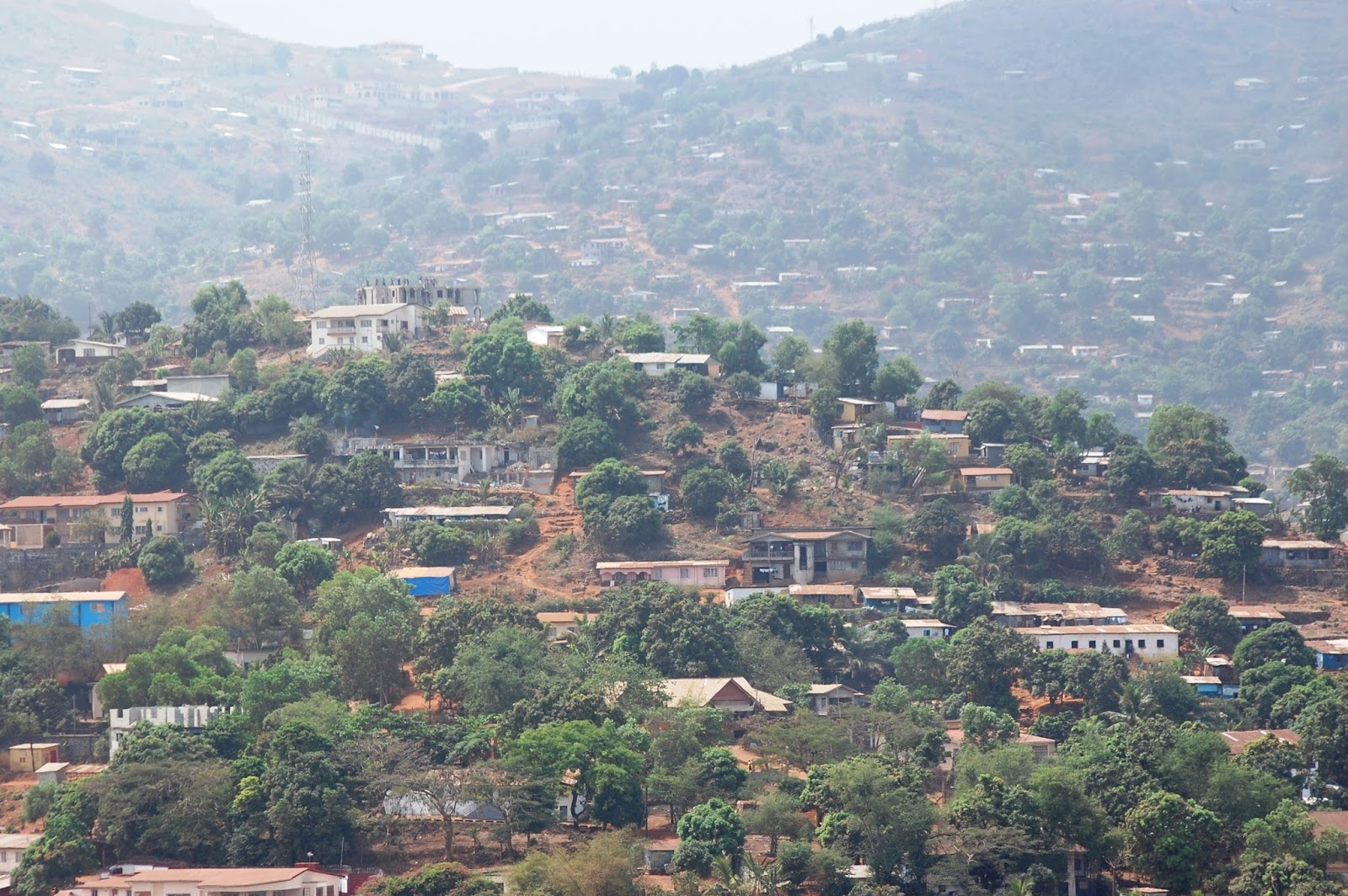
Freetown’s other geographic disadvantage comes from the way it lies on a strip of land, squeezed between a shoreline in front and a range of mountains behind.  So, when the rain falls, it cascades down in torrents of muddy water that washes over the town. At first glance, this combination would appear to provide the perfect recipe for disaster. But disasters of this kind are unheard of. Why is this so? 


Before we answer the question, let’s go back to the climate gurus and what they have to say about global climate trends. They tell us that global temperatures are set to increase over the next 50 to 70 years to a broiling 2˚C or more, if we are not mindful. That, we are warned, would probably be irreversible. For Sierra Leone itself, temperatures have, since 1960, increased by 0.8˚C, and are projected to rise by 1.0 to 2.6˚C by the 2060’s, and by 1.5 to 4.6˚C by the 2090’s. Meanwhile, recorded rainfall has gone in the opposite direction, decreasing significantly although it is not clear whether this was a trend, since some years were relatively wet whilst others were dryer. Anyway, these are all part of the mix that gives climate-watchers sleepless nights.


And, for the world at large, the prediction similarly, is that a rise in global temperatures of about 1.5 to 4.50C will occur and will be accompanied by various other climate-related disruptive events. In Sierra Leone, there is evidence that at least one of these consequences might be occurring already: One of its outlying islands, Bonthe, is showing signs of becoming inundated (Bonthe Island Is Sinking). The recent rainstorm over Freetown was another.  Perhaps the flooding might not have occurred if the city’s sentinel mountains had been able to soak up the rain that fell. But they could not, simply because the vegetation that used to hold the ground together and absorb the water had been stripped by unregulated and illegal clearing for the building of homes.


So, in retribution for this act of environmental vandalism, 50 years after the stripping of the mountain began, the rain came down and swept away some of those illegal structures in a tide that flooded streets and demolished coastal shanty towns as well. 


And thereby we find ourselves where we are today.


Tell Fren Tru

Saturday, 22 August 2015

Ebola ça Suffit-Let us Hope


Scanning Electron Micrograph of Ebola Virus (NIAID, NIH)
It was less than a year ago that the world seemed to be on the brink of catastrophe. There were predictions that hundreds of thousands around the globe would die from Ebola which, at the time, was raging in West Africa. Ebola, named after the river in the former Zaire near which the first recognized outbreak occurred in the 1970’s had, and still has no known cure. In an outbreak of the magnitude that was developing in West Africa, experts from all around the world were floundering as to how to stem its menace: Anyone that came into contact with body fluids of an infected individual was at considerable risk of becoming a patient too and became primed, thereby, themselves, to spread the disease in ever expanding ripples of contagion. That kind of infectivity, coupled with the ways in which the disease manifests itself - the fever, the diarrhoea, the vomiting, bleeding and bloodshot eyes, collapse in the streets- induced a state of terror that was almost medieval in scale. 

Things were not helped by how some sectors of the press stoked up fear by publishing irresponsible statements and wild speculation. As the epidemic progressed, it appeared once in America, that sanctum of wellness and purity: If the walls of citadel America had been breached, where else was safe? Civilization was at the brink. It seemed that the world would regress back to the Dark Ages in the short space of a few months. 

          But nothing like that happened, we are relieved to say. Instead, cool scientific heads systematically considered options. The real challenge was in the outbreak’s epicentre, West Africa, where serious obstacles stood in the way of coping with an epidemic of the scope that was this outbreak. Nevertheless, with public health and acute medicine specialists hanging heads, and with generous support from world governments and medical charities, it was hoped that the disease would remain largely confined to the three countries where it raged, even in the absence of specific treatment or preventive measures.

          Options for managing the epidemic that were considered include administering combinations of so-called monoclonal antibodies engineered in plants (ZMAPP), serum from patients convalescing from the infection, or direct anti-viral agents such as Avigan, an experimental anti-influenza virus agent.  These treatments, although conceptually sound, had the handicap of not having been widely tested in humans before, even though studies had shown that they were effective in animals. Another confounding factor was that none of these treatments was available in any quantity at all. Only a few patients, lucky enough to be carrying the right passport had the opportunity to get access. 

It would be idle to consider the ethical issues involved in deciding who got the treatment, where, how and when. The more important consideration was how to make the treatments available for all in need by scaling up production to hundreds of thousands and perhaps even millions of doses. No one wanted to put up the money for such massive emergency production without reasonable expectation that the products would be effective and safe when used on a community scale. But first, it was how to get round an even greater problem namely, the idea of treating sick patients with medicines that have not gone through the usually mandatory phases of pre-clinical efficacy and safety trials. It was argued back and forth about where the ethical balance laid between trialing treatments that had not gone through the preliminary stages of evaluating safety in sick patients and thereby putting them to unknown hazards on the one hand, while on the other, worrying about the ethical soundness of not treating people who were dying just because we were too timid to try 'newly-hatched and un-fledged remedies'.

However, in the confusion, the well-founded principle that viral diseases are better prevented than treated was not forgotten. But here again, it was not such an open and shut case either because, although candidate vaccines were available, they too, had not undergone the rigorous pre-clinical trials to confirm their safety. So, you’re damned if you do and damned if you don’t. 

          As it has turned out, we escaped damnation alright: the ordinary barrier procedures surrounding nursing, and burial of the dead, gradually ensured that disease transmission was interrupted among those caring for the sick and the dead whilst quarantine, an always inconvenient imposition, ensured that community transmission was curbed. Thus, by time of this writing, the incidence of new cases in West Africa has sunk to zero. And at this time too, the CDC reports a total of 27,988 cases worldwide, with11, 299 dead (CDC Ebola Update 3rdWeek August 2015). The figures are horrible enough, but considerably less dire than the holocaust predicted a few short months ago.

          The rapid fall in the numbers of affected individuals and people at risk had meant that testing other therapeutic measures would prove difficult, not to mention the ethical difficulties that I referred to earlier. But researchers from the WHO, United States, South Africa, Switzerland and Mali, crafted a field trial in Guinea of such elegance (dubbed with the slogan Ebola ça Suffit by the investigators) that issues of ethics and falling numbers could not stand in the way of demonstrating a 100% effectiveness of the trial vaccine, rVSV-ZEBOV (Ebola ça suffit).


          There has been much jubilation, rightly, at this breakthrough, achieved so quickly and against such odds. But perhaps there should be a note of caution. This is because there have been reports of a “post-Ebola” syndrome, consisting of arthritis, hearing loss and visual problems. And we should note that preliminary studies to determine the rVSV-ZEBOV best dose for the Ebola ça Suffit trial showed that at a certain level, some recipients developed arthritis, requiring scaling down of the dose.

The question that arises then is, if rVSV-ZEBOV is approved for general use, could there be a risk, in the long term, of similar complications developing in those receiving the vaccine? 
   

Tell Fren Tru
Tuesday, 21 July 2015

Moaning in Toronto


You know the silly season is here when the death of a racoon on a city street makes the obituary columns. I would probably not have taken much notice of the reports myself except that the creature apparently died just round the corner from where we live.
In the nature of things, racoons everywhere die all the time, whether they enjoy an urban life or reside in their country habitat. Also, few would normally shed a tear when a racoon passes on, least of all for city-dwelling racoons. These are animals that do not normally endear themselves to city humans, principally because of their habit of upsetting our garbage bins during the night and leaving the mess for us to clear up.
But July is the month when public sources of entertainment dry up. Politics, especially, is at an ebb, with Parliament in recess and politicians find themselves at a loose end, with fewer opportunities to keep their mouths shut except at the traditional constituency barbecue. True, there could be music entertainments of all kinds, jazz, pop, classical, etc. Besides, every weekend sees some street party or the other in celebration of the city’s cultural diversity.  And of course, there are the staple shootings, stabbings, road rage and other fracas that keep the police busy. All predictable, but apparently not quite enough to satisfy our desire for something out of the ordinary. Even something as big as the Pan-American Games coming to town was, initially, not enough to get residents animated, leading to no less than the New York Times harrumphing that, “most Torontonians seem to be greeting the event with a shrug” (NYTPanAMGames) And, not until the country’s athletes started winning shedloads of medals did the city wake up to the possibility that something special might be going on on their doorstep.
But it seems that when it comes to dead racoons, we get pumped up enough to send messages around the world through the internet.  How else can one explain the sensational spread of an inconsequential story of a racoon dying at a street corner in mid-town? (DeadRacoon) Of course the term “viral” has acquired a whole new meaning in the last few years, perhaps without a full appreciation of the word’s provenance or of how the original can be a potential killer not to be trifled with.
Tell Fren Tru

Monday, 22 June 2015

We hold these truths to be self-evident...


What is it about America and race? Why does that country obsess so much about it? And, if you ask Americans, I doubt whether they themselves can give a coherent explanation why it looms as large as it does in their nation’s psyche.

In less than one year, there have been at least half a dozen occasions when race in America became the focus of not only national but international attention as well. Here is a sample of some of the more notorious ones:

·        July 17, 2014, Eric Garner died in New York City, after a police officer locked him in a chokehold. 

·        August 9, 2014, an 18-year-old man, Michael Brown, is fatally shot by Darren Wilson, a Ferguson MO cop. 

·        April 4, 2015, Patrolman Michael Slager fatally shoots Walter Scott in the back following a traffic stop for a non-functioning brake light in North Charleston, South Carolina.

·        April 12, 2015 Freddie Gray suffers a fatal spinal injury while being transported in a Baltimore MD police van that made several rough stops, starts and turns. Gray did not have a seat belt on. His only restraint apparently was handcuffs, a latter-day version of the Middle Passage.

·        June 5, 2015 Officer Eric Casebolt, a McKinney TX cop is filmed pulling his gun on a bunch of teenagers at a pool party. He wrestles a 14 year-old girl to the ground for good measure. 

·        June 10, 2015 Rachel Dolezal, the Spokane WA NAACP president is outed by her parents. She had been “passing” as black for many years.

·        June 17, 2015 Dylann Roof, a 21 year old joins a Bible Study group in Charleston SC’s Emanuel AME Church and sits in quietly for an hour. Then, declaiming hatred, he pulls out a gun and opens fire on the group of churchgoers he was ostensibly studying with. He kills nine of them.

The thing about these incidents is that, in nearly all, the victims are black. The exception is Rachel Dolezal's, whose journey to victimhood may have been partially self-mediated although eventually sparked by intra-family dysfunction. 

When you stand back, the dynamic in the majority of these encounters favours those with the power. Yet, those wielding power, influence and authority never seem satisfied unless the disadvantaged are rendered even more disadvantaged and, still better, dead. True, no one in his right senses would describe Mr Roof, the alleged assassin in the Bible Study murders as powerful and privileged (America, that bastion of the classless society has a term for individuals like this) but such is the overwhelming grip of racism in America that it pops up in the most improbable of circumstances.

There are two reasons why I am writing this post. One is that, what happens in America and what America does have resonance for the entire world; American Law is virtually World Law and all of us are expected to tow its line. Just ask FIFA. Besides, America would not have come about except for their expressed conviction thal all men are created equal. They say that upfront in their Declaration of Independence document.

The other reason is that American racism is just another iteration of tribalism. And while we in Africa now generally experience little racism, tribalism is alive and well throughout the continent. It is an ism that is every bit as corrosive as America’s principal moral failing. Perhaps even worse.

Tell Fren Tru