I have been under the weather over
the last fortnight or so, which partly explains why Tell Fren Tru has been
silent. Talking about weather, Sierra Leone and its capital, Freetown, has also
been, more explicitly, under the weather too. Last Wednesday, in just four
hours, enough rain was dumped on the capital to nearly drown it. According to
reports, much of the low lying land was under water and hundreds of dwellings were
swept away, leaving thousands homeless. In the event, it was a lucky break that
casualties amounted to just seven dead.
Freetown is capital
to one of the poorest countries in the world and could ill-afford another
onslaught following so close on the heels of an Ebola epidemic from which it still
has to recover. And then this. But, the city is, in some ways, a victim of its
geography, sitting where it does, exposed to the worst excesses of a turbulent Atlantic
ocean. Those excesses are most evident during the monsoon season that falls between
May and October, the wettest months being July, August and September. The
meteorologists say that during the season, moist air from the south Atlantic blows
on to the land, dousing the Sierra Leone peninsula with more than 3000 mm of
rain every year, making Freetown one of the world’s wettest capitals.
Freetown’s other
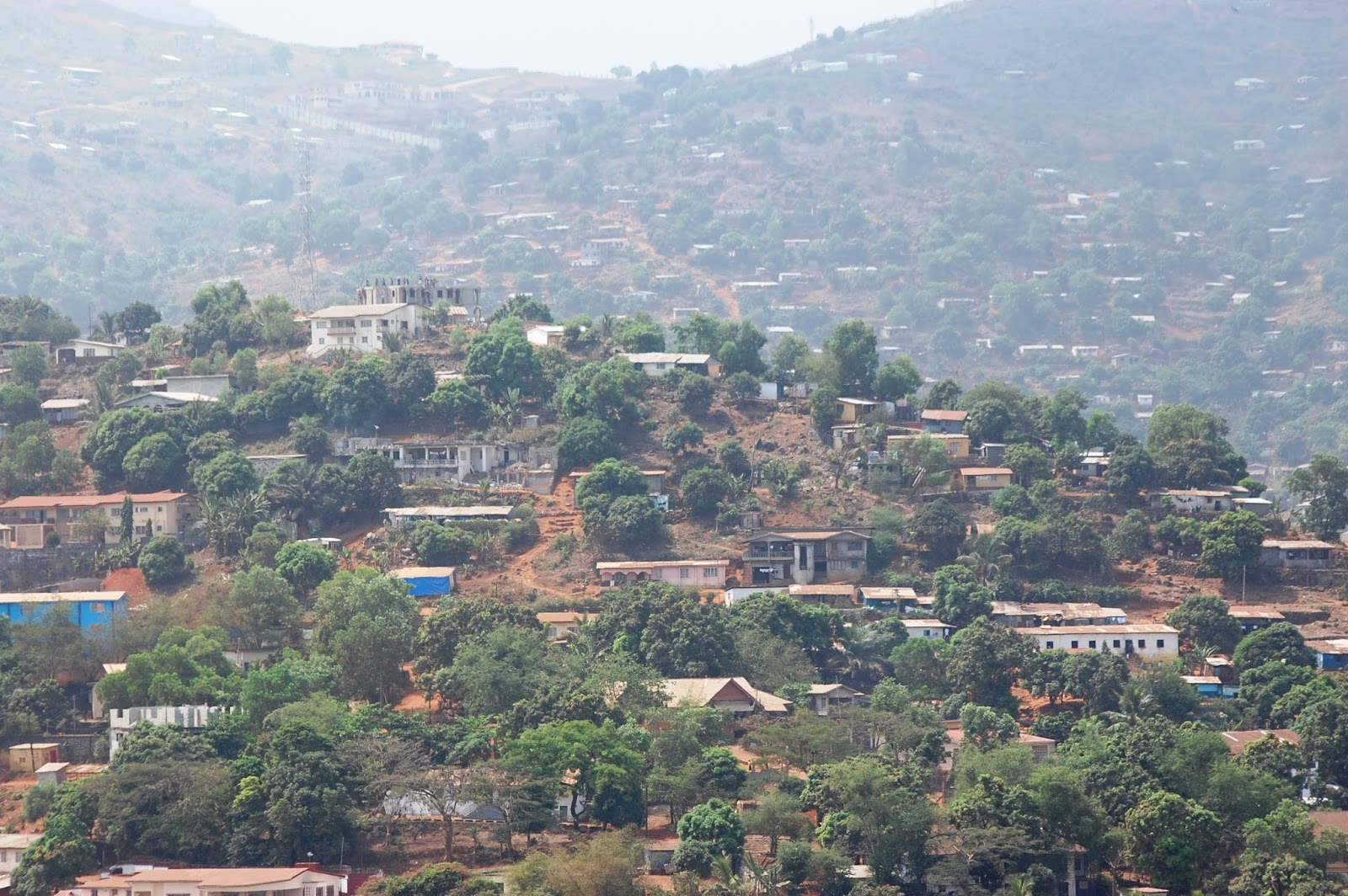
geographic disadvantage comes from the way it lies on a strip of land, squeezed
between a shoreline in front and a range of mountains behind. So, when the rain falls, it cascades down in
torrents of muddy water that washes over the town. At first glance, this
combination would appear to provide the perfect recipe for disaster. But
disasters of this kind are unheard of. Why is this so?
Before we answer
the question, let’s go back to the climate gurus and what they have to say
about global climate trends. They tell us that global temperatures are set to
increase over the next 50 to 70 years to a broiling 2˚C or more, if
we are not mindful. That, we are warned, would probably be irreversible. For
Sierra Leone itself, temperatures have, since 1960, increased by 0.8˚C,
and are projected to rise by 1.0 to 2.6˚C by the 2060’s, and by 1.5 to 4.6˚C by
the 2090’s. Meanwhile, recorded rainfall has gone in the opposite direction,
decreasing significantly although it is not clear whether this was a trend, since
some years were relatively wet whilst others were dryer. Anyway, these are all
part of the mix that gives climate-watchers sleepless nights.
And, for the world
at large, the prediction similarly, is that a rise in global temperatures of
about 1.5 to 4.50C will occur and will be accompanied by various
other climate-related disruptive events. In Sierra Leone, there is
evidence that at least one of these consequences might be occurring already: One
of its outlying islands, Bonthe, is showing signs of becoming inundated (Bonthe
Island Is Sinking). The recent rainstorm over Freetown was another. Perhaps the flooding might not have occurred
if the city’s sentinel mountains had been able to soak up the rain that fell.
But they could not, simply because the vegetation that used to hold the ground
together and absorb the water had been stripped by unregulated and illegal clearing for the building of
homes.
So, in retribution
for this act of environmental vandalism, 50 years after the stripping of the
mountain began, the rain came down and swept away some of those illegal
structures in a tide that flooded streets and demolished coastal shanty
towns as well.
And thereby we
find ourselves where we are today.
Tell Fren
Tru
 Twenty twenty-two was
a year and a half. Now, thankfully, we have seen its back with that of one of
the existential issues of our times. I speak of Covid-19, of course, which, during
its peak, had confined most of us to barracks. Happily, the majority of us survived
it, and are now returning to something like normalcy. We are still not yet back
to the relaxed ways of pre-pandemic days, though. Whatever satisfaction we may
feel at this point, it is well to remember that the pandemic has taken nearly 7 million lives. These
dead are not just numbers. They left behind deeply scarred families who watched
their loved ones sicken and die. The worst is now over. Probably. We must spare
a thought though, for those among us who avoided Covid’s worst outcome, yet survive
to contend with the debilitating symptoms of “Long Covid”.